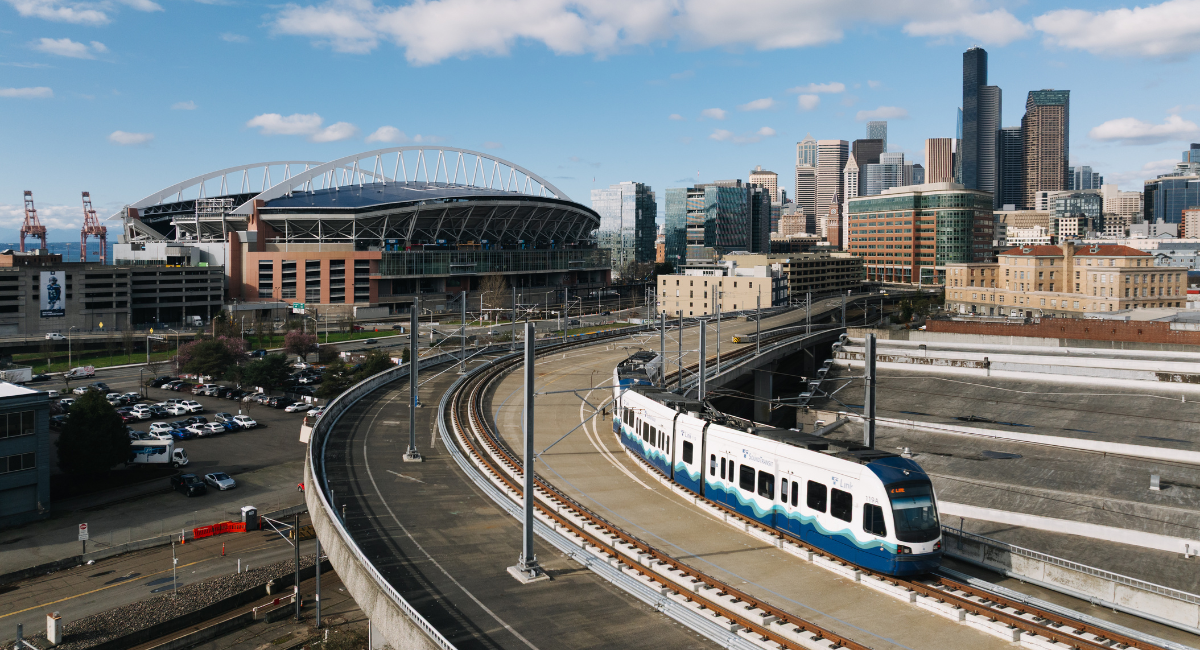
The greater Seattle region will experience expanded public transit use in late March, thanks to the opening of a new connection across Lake Washington between the existing light rail 1 Line in Seattle and the 2 Line on the Eastside. The region’s decades of work to connect suburban and urban communities isn’t just good for travel; it has important impacts on public health.
“Public transit is a public health intervention,” said Andrew L. Dannenberg, an affiliate professor of environmental and occupational health sciences and urban design and planning at the University of Washington. “This is a very positive step forward for the Seattle metropolitan region and for public health.”
High quality, reliable, and frequent public transit improves people’s physical activity, as people usually walk or bike to and from their transit stops. Transit also connects them to opportunity, improves air quality, and supports road safety. Even Washingtonians and visitors who don’t use public transit may experience the benefits of reductions in road traffic from more people using transit.
“Getting around the Puget Sound on transit is an excellent way to get in tune with your community and add some movement to your day,” said Sound Transit’s Program Manager for Transit Safety Seth Daphne Esmeson. “Whether you’re walking or rolling to your station, it’s important to look both ways, slow down to smell the roses, and take in the sights and sounds of your neighborhood.”
Light rail can add value that buses can’t, Dannenberg said. Light rail is seldom impacted by road traffic, can carry more riders than buses, and comes more frequently than most bus routes. When light rail runs at least every 10 to 15 minutes, like Sound Transit’s light rail connections do, Dannenberg said riders do not need to tie their schedules to a specific timetable and can head to a station whenever suits their schedule. Light rail can also shape the communities around it.
“Fixed rail can attract what's called transit-oriented design, which says we can build both housing and jobs near the transit stations because transit stations tend to be stable," Dannenberg said. “A rail system carries more people, is more reliable and is more permanent than buses so that you can attract development around it in ways that benefit society.”
Dannenberg’s research and teaching have focused on examining the health aspects of community design, including land use, transportation, urban planning, equity, climate change, and other issues related to the built environment. Dannenberg contributed to a recent report that highlights seven ways public transit can improve the public health of communities:
1. Physical activity
By walking, biking, rolling (and occasionally sprinting), to the bus or train, transit users often have physical activity built into their commutes. Public transit use is associated with reduced rates of cardiovascular disease and mental health symptoms as well as reduced falls in the elderly. Research has found that using public transit three or more times per week is associated with lower health care costs compared to using public transit less often.
2. Opportunity
Economic opportunities are accessible to more people when they have reliable public transit. Individuals can use transit to broaden the range of jobs and schools to which they have access. In the U.S., $1 invested in transit yields more than $1 in economic growth in the cities with the highest public transit use. Research also found that by reducing the financial costs from transportation, people have more money to spend on healthy food, health care, and housing.
3. Air quality
Public transportation can improve air quality by reducing emissions from cars. This decrease in harmful emissions is linked to reductions in strokes and heart and lung diseases, as well as reduced greenhouse gasses. As buses and light rail are upgraded to low or zero emission energy sources, air quality will continue to improve in communities.
However, there are complexities to this. Because public transportation users, pedestrians, and bicyclists may spend longer periods traveling and may breathe more heavily during their trips, they can experience greater exposure to certain air pollutants.
4. Social cohesion
Public transit can help people maintain their in-person relationships, especially for people who can’t drive. These strong social relationships are important for longevity, mental health, and combatting the loneliness epidemic. Research also suggests sharing public spaces like transit or parks may lead to more social interactions with community members. Well-designed transit lines can also help improve social connectedness in neighborhoods that have been historically disconnected by highway infrastructure.
5. Healthy places
Public transit connects people to services that keep them healthy, like clinics, grocery stores, jobs, schools, and green spaces. Having reliable and frequent access matters. Removing transit barriers increases visits to routine and preventative health care, which in turn reduces emergency room visits and prescriptions written for patients. In rural areas, lack of transit is a barrier to accessing healthy food.
To maintain these economic benefits, it’s important that affordable housing be near public transit lines. To prevent displacement that can occur when new transit lines make a neighborhood more attractive, communities can consider a range of policies including land trusts, developer incentives, and affordable property protections.
6. Road safety
By reducing vehicles on roads, public transit can help reduce injuries and deaths from vehicle collisions. This is especially helpful in protecting youth, as unintentional injury, including motor vehicle crashes, are the leading cause of death for teens in the U.S. However, improving road safety doesn’t stop at removing vehicles from roads. Quality transit systems should be designed so that roads and street crossings around transit stops are safe for pedestrians and bicyclists, who are most at risk of serious injury in collisions.
7. Personal safety
Research shows that high-quality public transportation systems can reduce crime rates in communities. People who feel safe on public transit are more likely to use transit, and more riders can in turn help people feel safer. Measures such as adequate lighting, emergency buttons, and clear signage help riders feel secure, as do efforts to reduce evening and night wait times. When transit stations and surrounding areas feel safe, and when systems operate reliably and frequently, riders experience improvements in both mental and physical health due to reduced fear and stress.
Dannenberg suggests that transit agencies highlight the health benefits of public transit when trying to attract new riders and when seeking additional resources to expand public transit services.
“Quality public transit is great news for our communities and our health," Dannenberg said. “Awareness of the health benefits of transit can help our communities understand why this access matters for all of us.”