In Case of Emergency
If you are a student facing an emergency, please use the UW emergency contacts page.
General Feedback
The School of public Health (SPH) welcomes feedback about your student experience. This may include classroom conditions, course options, or student support. Your constructive comments can improve the student experience. You can share feedback in several ways:
- Talk with a staff or faculty member, your program manager or director, or the chair of the department that houses your program.
- Contact the assistant dean for students or the associate dean for education.
The School of Public Health works to create a respectful, inclusive, and supportive place to learn and work. Support is available. You do not have to handle issues by yourself. If you are not sure who to contact or how a UW process works, please email sphsas@uw.edu.
Addressing Concerns and Grievances
The University of Washington and the School of Public Health have steps to handle most concerns and grievances. The information below explains some of these steps. To discuss a process, or to ask about a concern that is not listed, contact the assistant dean for students. Most concerns are handled informally, such as through a conversation between the people involved. However, SPH or UW usually cannot take formal action unless a formal process is followed. Students seeking a disciplinary process may use the other reporting options below.
How Different Types of Student Concerns are Handled in SPH
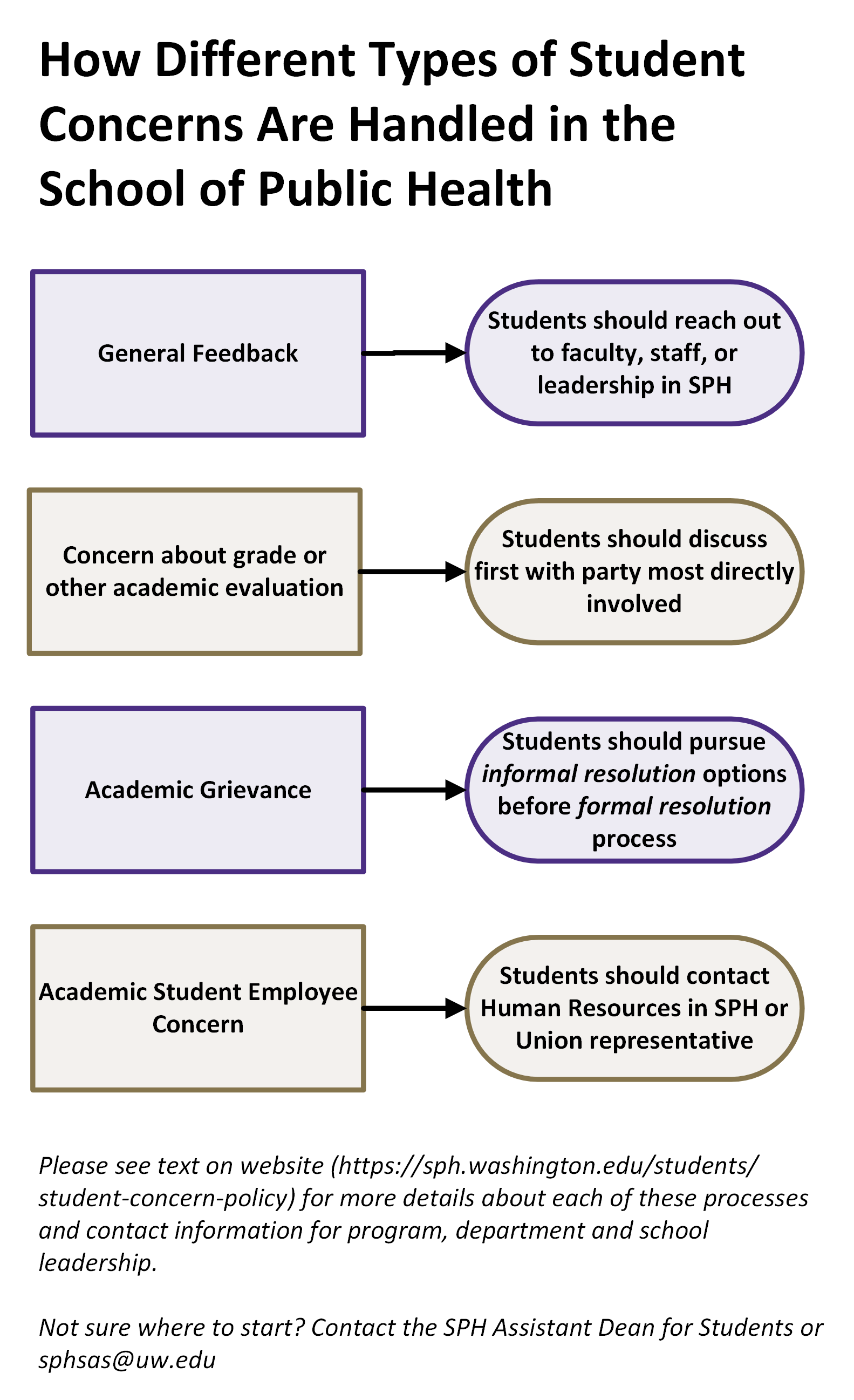
Looking for additional support? The UW Office of the Ombud helps protect the rights of people in the UW community. At the request of someone involved, the Ombud can serve as a neutral assistant to support an early, informal solution. The Ombud may become involved at any stage of the grievance process.
If you think an instructor made a mistake in assigning or recording a grade, you must raise the issue by the end of the next quarter (not including summer quarter). Use the same deadline for concerns about other academic evaluations, such as a capstone, practicum, or thesis. The process may take two steps. First, talk with the instructor or, when appropriate, your project supervisor, capstone chair, or thesis chair. If the issue is not resolved, use the SPH Student Concerns Form to submit a written appeal within 10 days of that conversation. This appeal will be directed to the chair of the department that houses your program. For an interdisciplinary program housed in the SPH Office of the Dean, your written appeal will be directed to the associate dean for education. Appeals about grades in MPH Core classes will be directed to the associate dean for education. Learn more about grade changes and grade appeals.
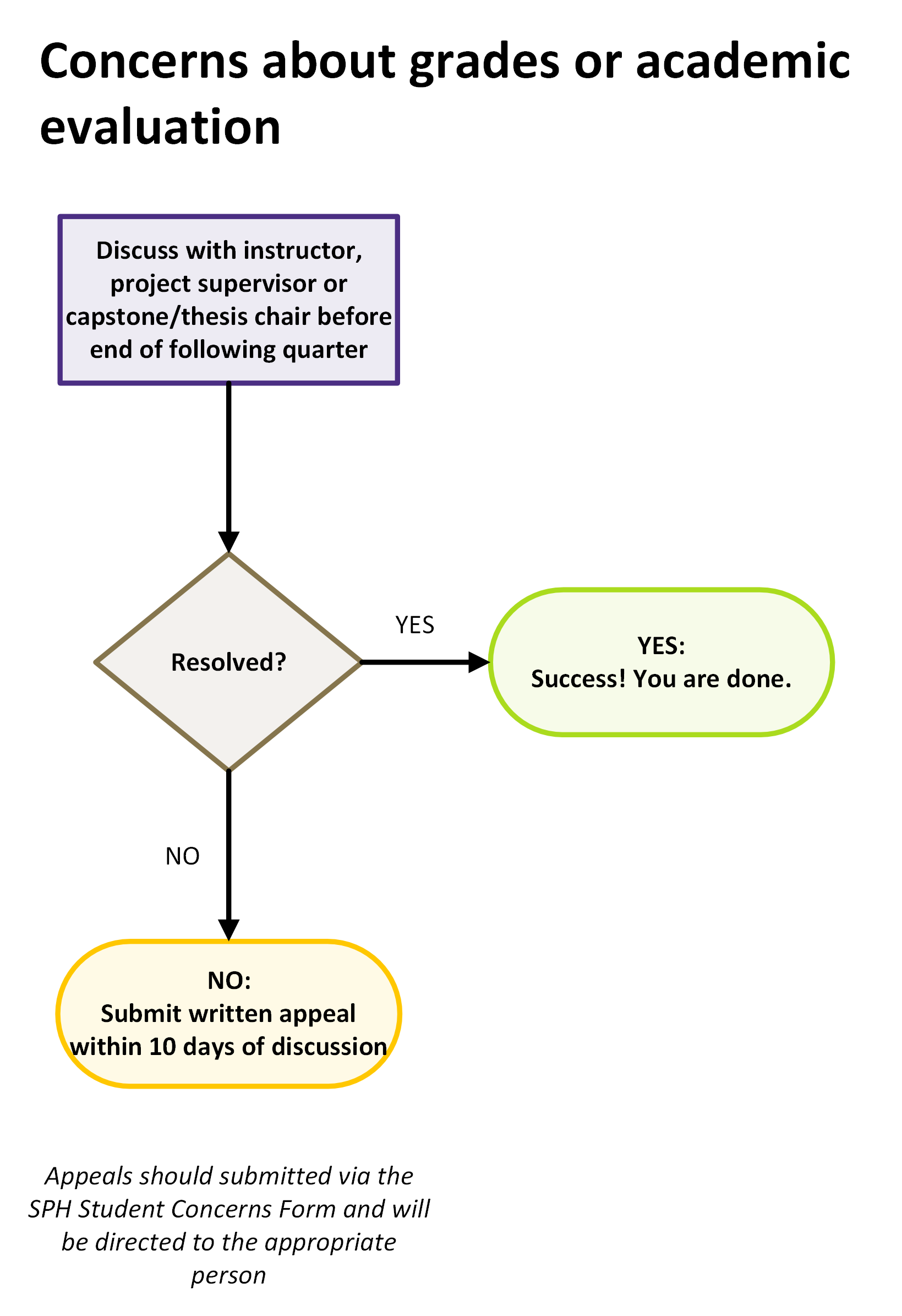
The SPH grievance process is meant to resolve student academic concerns promptly and fairly. Concerns may involve UW, Graduate School, SPH, or departmental policies that affect a student’s academic rights or choices. They may also involve a course instructor not following stated grading methods, fair treatment, or similar issues. A concern about one specific grade follows the grade appeal process instead.
You must start an informal request or file a formal concern within three months of the incident. At the time of the incident, you must have been registered, on leave, or on summer break. Before filing a formal grievance, students are usually expected to make a sincere effort to resolve the concern informally.
Informal Resolution of Academic Grievances
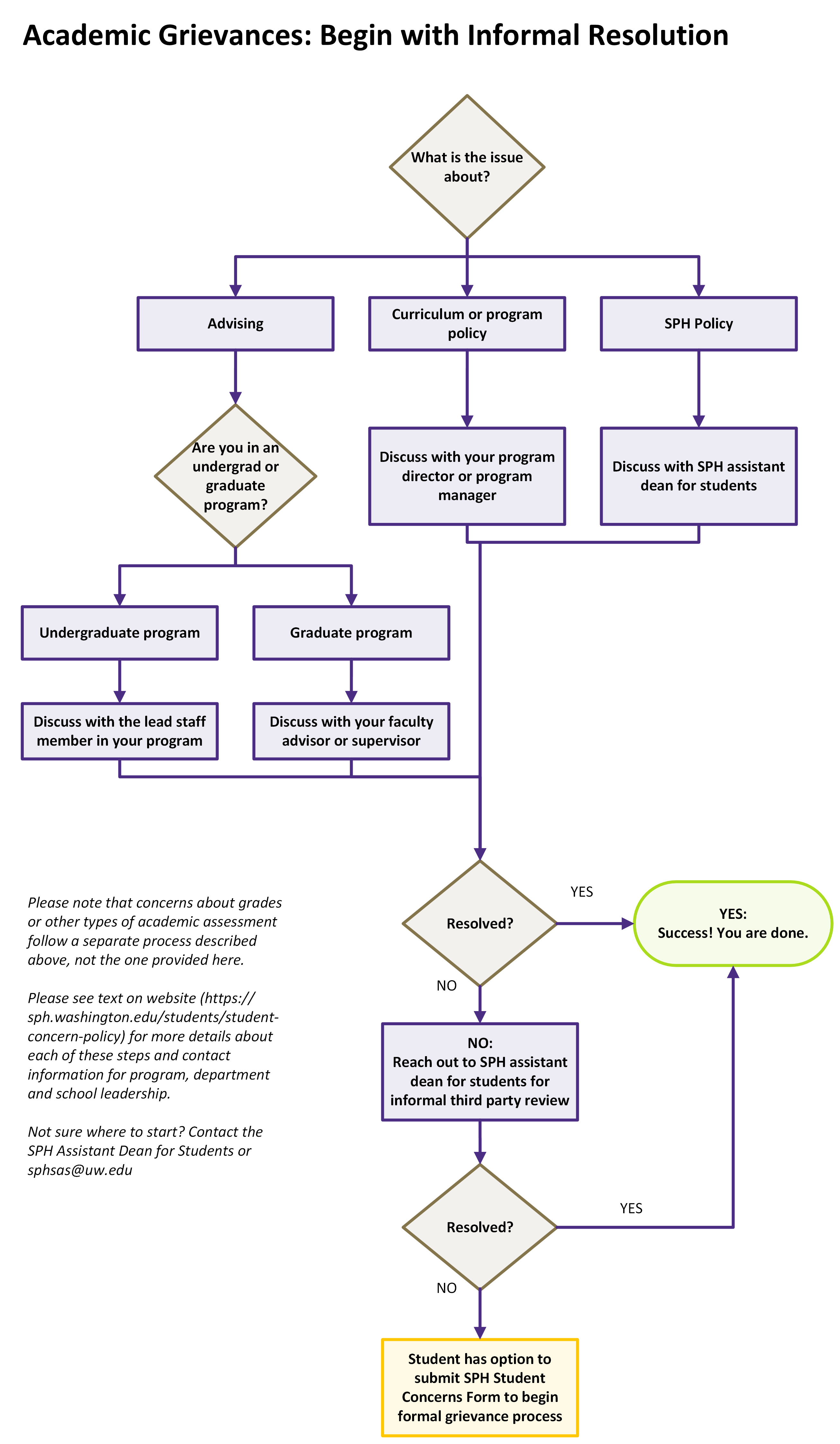
First, make a sincere effort to resolve the concern with the faculty or academic staff member most directly involved.
- For a curriculum or program policy concern, first contact your program director or manager and try to resolve it informally.
- For an advising concern, first try to resolve the issue with the person listed below:
- Undergraduate students: Contact the lead staff member for your program. This is the academic services director in PH-GH and FSNH, the associate director for academic programs in EPH, or the program manager in HIHIM.
- Graduate students: Contact you faculty adviser or project supervisor.
- For a concern about an SPH policy, first contact the assistant dean for students and try to resolve it informally.
Everyone should make a sincere effort to resolve the concern at this level. Many concerns can be resolved through conversation. A solution might include recognizing the harm, apologizing, promising to improve, or reaching a compromise that helps the person who raised the concern. Please consider whether the response and solution are acceptable before proceeding to the next step
If direct communication does not lead to an acceptable solution, you may contact the assistant dean for students. The assistant dean can review the situation more objectively and try to help resolve it informally.
The assistant dean for students may share a concern with the dean or another responsible SPH leader, such as a department chair, the associate dean for faculty, or the director of human resources. The dean or their designee may also take administrative action, especially when a UW employee is involved. This action may happen separately from the student concern process.
If the informal process does not resolve the concern, the next step is to file a formal concern using the SPH Student Concern Form.
Submitting a Formal Academic Grievance
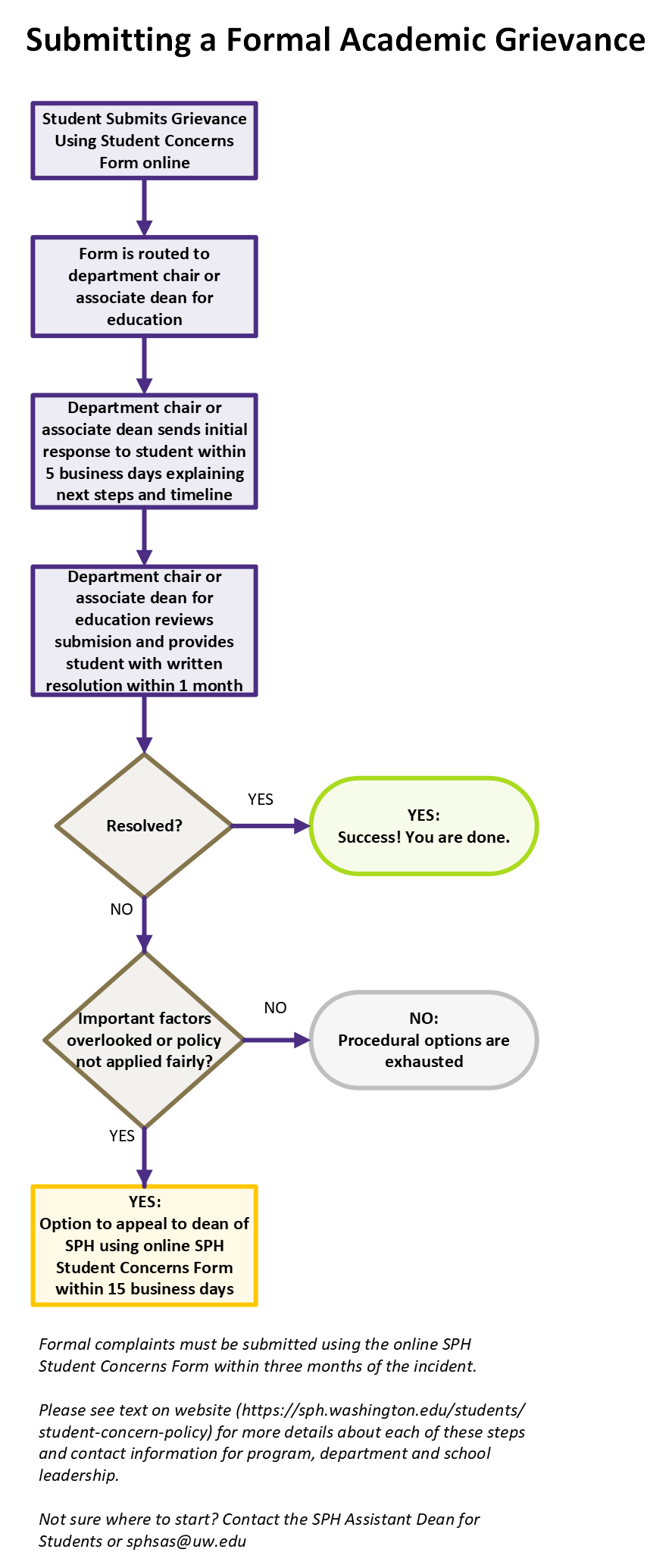
- How to submit your concern. Begin a formal academic grievance by submitting a written concern through the SPH Student Concern Form. The form will go to the chair of the department that houses your program. For an interdisciplinary program housed in the SPH Office of the Dean, it will go to the associate dean for education. Submit the formal grievance within three months of the incident.
- Who makes a decision. The department chair (or the associate dean for education for an interdisciplinary program in the SPH Office of the Dean), makes the final decision on efforts within the department (or interdisciplinary program) to resolve the concern. You should receive an initial response within five business days after you submit the grievance. When needed, a timeline will be provided for next steps. The chair or associate dean will ask you to confirm that you tried informal resolution or had a string reason to skip it.
- Notification of decision. The chair or associate dean should send you a written decision within one month after you submit the grievance. The chair or associate dean will be using their judgement to reach a fair decision considering the facts available to them and the relevant written policies, procedures, or established local customs. Their decision may not result in the outcome you prefer but should be considered a fair response. Consider whether the response and solution are acceptable before considering an appeal.
- Other possible outcomes. The department chair or associate dean may share a grievance with the dean or another responsible SPH leader. The dean or a designee may take administrative action, especially when a UW employee is involved. This action may happen separately from the student concern process. Administrative actions are often confidential, so students may not be told whether an administrative action is happening or what the outcome is.
Appealing a Formal Academic Grievance to SPH Dean
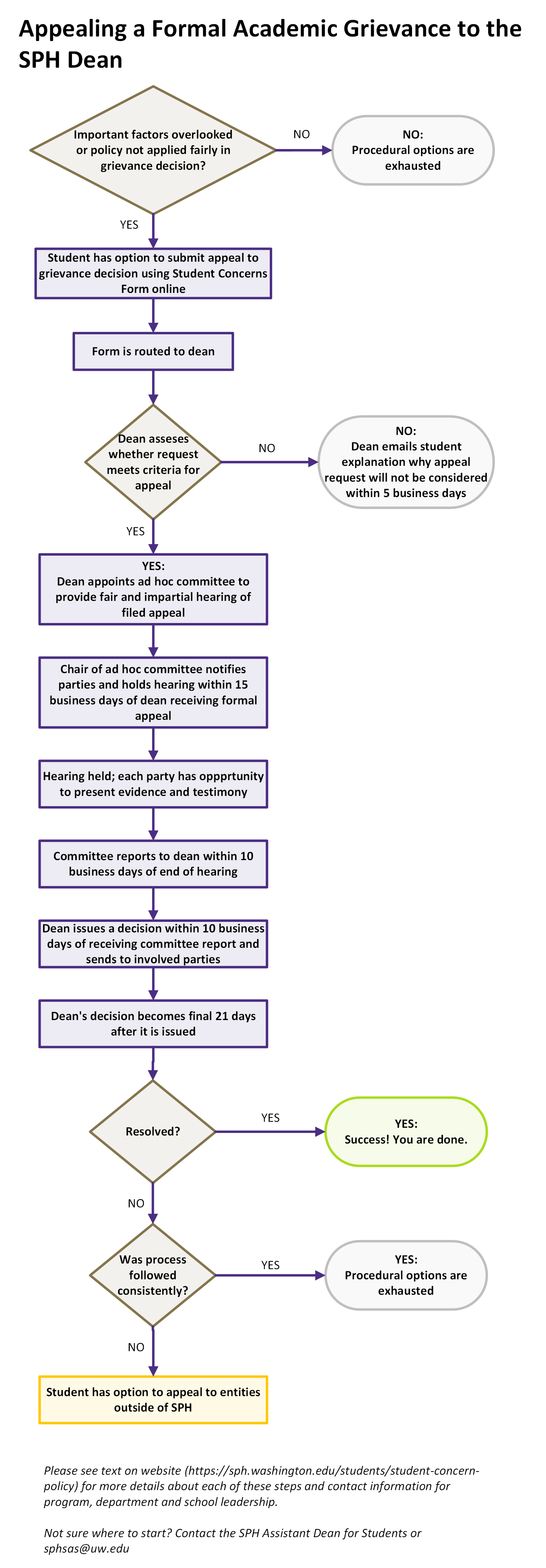
If you think the department chair or associate dean did not apply or interpret policies or procedures correctly, you may appeal to the SPH dean. To submit an appeal to the SPH dean, use the SPH Student Concern Form. Appeals must be submitted within 15 business days after the written decision was issued by the department chair (or associate dean).
- Initial intake process. Upon receipt of the written appeal from the student, the dean will determine whether the appeal request meets the criteria for an appeal:
- The dated written decision issued by the department chair (or associate dean) is provided in the appeal submission AND
- The appeal was submitted online within 15 business days after the written decision was issued AND
- The student has provided evidence in the appeal submission that suggests the department chair (or associate dean) did not apply or interpret policies or procedures correctly.
- If the appeal request does not meet these criteria, then the dean will send an email to the student explaining why the appeal request will not be considered. This email should be sent within 5 business days of the dean receiving the appeal request.
- Appointment of ad hoc committee. If the appeal request meets these criteria, then the dean will appoint an ad hoc committee consisting of three tenured faculty members and two students and refer the matter to that committee. The chair of the committee shall be a faculty member appointed by the dean. It shall be the responsibility of the committee to provide the student with a fair and impartial hearing regarding the filed appeal.
- Notification of parties. The dean of the School of Public Health will notify all persons directly involved and provide each with a copy of the written appeal. The chair of the ad hoc committee shall establish a time and place of the hearing to be held within 15 business days after the receipt of the formal appeal by the dean.
- Hearing process. Each party may present evidence and testimony that supports or challenges the appeal. The committee will consider only evidence presented at the hearing. The hearing will be closed to the public. The student may bring an adviser or support person, but that person may not speak during the hearing. SPH will keep a record of the proceedings for five years, in keeping with the UW records retention policy.
- Committee report to dean. Within 10 business days after the hearing ends, the committee will send a report to the dean, and everyone involved. The report will include the facts, conclusions, and recommendations. The committee will decide by majority vote. Members who disagree may include a separate opinion.
- Notification of decision. Within 10 business days after receiving the committee report, the dean will issue a decision. The decision will explain the reasons and list any actions that will be taken. SPH will send it to everyone involved.
- Finalization of decision. The dean’s decision becomes final 21 days after it is issued.
Appealing a Formal Academic Grievance Outside SPH
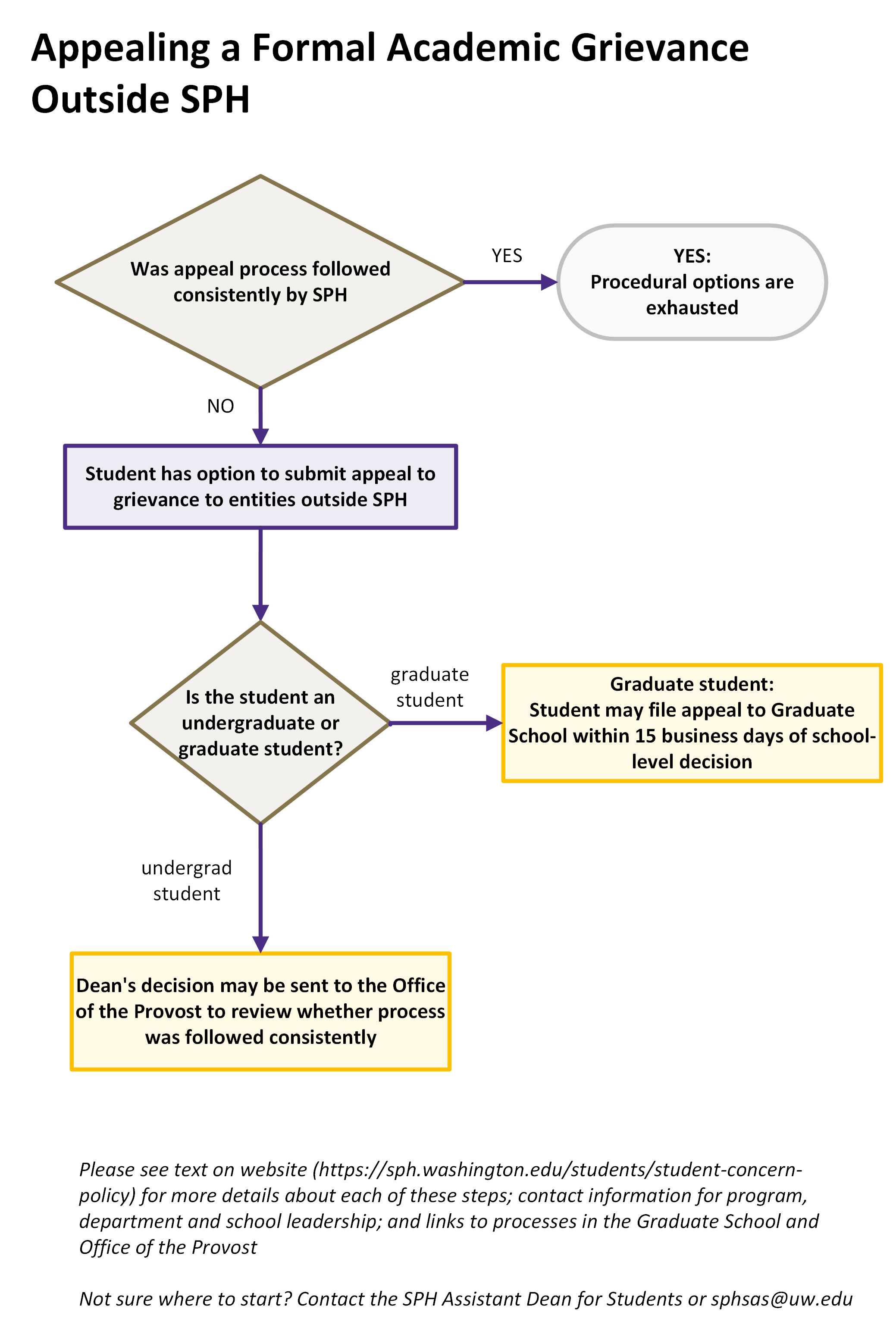
- Undergraduate and non-matriculated students: After the school-level concern process ends, the dean’s decision may be sent to the Office of the Provost to review whether the proper process was followed consistently.
- Graduate students: You may appeal based on whether the proper process was followed consistently by the dean of the School of Public Health. File the appeal within 15 business days after the school-level grievance process ends. The Dean of the Graduate School will manage the appeal under Graduate School Policy 3.8.
Academic Student Employees who have questions about their appointment, concerns at work, or need help finding resources may contact:
- The human resources manager for the department that houses your academic program.
- The central UW Human Resources Consultant for SPH.
- The SPH Dean’s Office Human Resources Manager (gosphahr@uw.edu).
- Your union representative.
The University specifically prohibits discriminatory or harassing behavior against any member of the University community. Students who believe they have been discriminated against by an employee on the basis of race, color, creed, religion, national origin, citizenship, sex, age, marital status, sexual orientation, gender identity or expression, disability, or military status should refer to the procedures through the Civil Rights Compliance Office.
If you think you have experienced or witnessed misconduct by another student, report it to the Office of Community Standards and Student Conduct. This includes behavioral and academic misconduct, such as plagiarism or cheating. UW will review the concern under the Student Conduct Code.
Students with concerns about a DRS approved accommodation should reach out to your DRS Coordinator right away. If you would like assistance navigating DRS processes or other support with access and accommodations, please to reach out to the SPH Access and Advocacy Coordinator.
Students with safety concerns can contact SafeCampus, Emergency Management and the UW Police Department (UWPD).
- If you suspect financial or ethics activity that breaks a law, rule, requirement, or UW policy, report using the toll-free number 1-844-518-1420 or use the ethics and fraudulent activity reporting form.
- Report concerns about research misconduct to the UW Office of Research Misconduct Proceedings.
- The UW School of Public Health is accredited by the Council on Education in Public Health (CEPH). If you have a concern about accreditation standards not being met, you can reach out to the SPH Associate Dean for Education or you can file a complaint directly to CEPH.